B Pharm Fees in UP 2026 Government vs Private College Comparison
Are you a student interested in pharmaceutical science, drug development, and healthcare provision? Then the Bachelor of Pharmacy is a lucrative undergraduate program for you.
But here is a question that keeps every pharmacy aspirant awake: “Should I wait 2-3 years hoping for a government seat, or invest in a private college and start my pharmacy career immediately?”
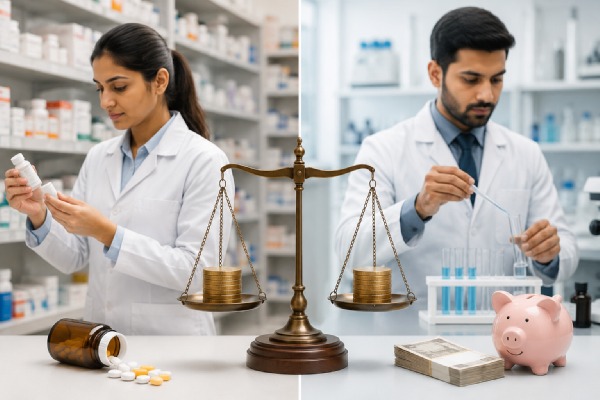
The B Pharm fees in UP are one of the biggest factors when choosing between a government and private pharmacy college for many students. The fact is, the fee structure in UP for most institutes isn’t just about tuition fees.
Students must consider that their costs include academic resources, industry exposure, placement assistance, infrastructure, lab facilities, hands-on learning, and the general learning environment.
Given that, if you are comparing the B Pharm course fees in UP, don't simply ask, “Which college charges less?” Instead, ask: “What am I getting for the fee I am paying?”
Let's break it down.
B Pharm Fees Structure in UP: Government Colleges Breakdown
Annual fees for Government B Pharm Colleges in Uttar Pradesh in 2026 are as follows:
|
College Name |
Location |
Complete 4 Year Fee (Approximately) |
Entrance Exam |
Seats |
|
Delhi Institute of Pharmaceutical Sciences (Delhi, but accepts UP) |
Delhi |
₹3.45 lakh to ₹3.60 lakh |
CUET-UG |
120 |
|
Faculty of Pharmacy, Lucknow University |
Lucknow |
₹4.81 lakh to ₹4.87 lakh |
CUET-UG |
100 |
|
MMMUT Gorakhpur |
Gorakhpur |
₹5.16 lakh to ₹10.43 lakh |
CUET-UG / University admission process |
60 |
|
Bundelkhand University |
Jhansi |
₹3 lakh to ₹3.2 lakh |
CUET-UG |
60 |
|
UPUMS |
Saifai, Etawah |
₹67,000 to ₹86,200 |
CUET-UG |
60 |
The fee structure of these government B Pharm Colleges in Uttar Pradesh can make them an attractive option for students looking for an affordable pharmacy degree. As said before, fees alone do not determine the overall value of a college.
So, before choosing a government college only because of its lower B Pharm fees in UP, it is important to understand what students can realistically expect from these institutions.
What Your Government Fee Structure Gets You
- B Pharm fees UP government colleges are highly affordable: ✔️
- Limited lab equipment; it may be outdated by 5-10 years: ❌
- Faculty shortage, and there are many vacant positions: ❌
- Minimal industry exposure: ❌
- Poor placement infrastructure: ❌
- Average package: ₹3.5-5.5 LPA: ❌
The Future Outcome? 40% of government college graduates work in jobs unrelated to pharmacy due to poor placement support.
Private College B Pharm Fees UP
B.Pharm from a private college is different from government ones. Private colleges level up the game with better labs, industry exposure, internships, and placement opportunities. Nonetheless, it is evident that these advantages often come with a higher price.
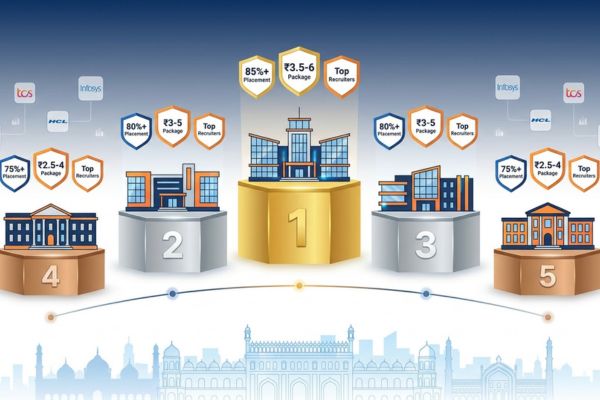
On that note, here’s a quick tier-wise breakdown for B Pharm fees in UP to help you understand what you may get at different fee levels:
|
Tier |
College Examples |
Complete 4 Year Fee (Approximately) |
Facilities |
Entrance |
Average Package |
|
Tier-1 |
Amity, Shobhit, and GIET |
₹2.82 lakh to ₹17.8 lakh |
International accreditation and MNC placements |
CUET-UG / University-level admission |
₹8-12 LPA |
|
Tier-2 |
Galgotias and Noida International |
₹2.83 lakh to ₹5.5 lakh |
AICTE accreditation and decent placements |
CUET-UG / University-level admission |
₹5-8 LPA |
|
Tier-3 |
Regional private colleges |
₹2.53 lakh to ₹4.5 lakh |
Basic facilities and moderate placements |
CUET-UG / Merit-based admission |
₹3.5-5 LPA |
|
Tier-4 |
Smaller private colleges |
₹2.5 lakh to ₹5 lakh |
Limited facilities and few placements |
Merit-based / College-level admission |
₹2.5-4 LPA |
Is paying the higher fee for B. Pharm even worth it? Well, to answer that question: Yes. Paying more for a private B. Pharm college in UP can mean access to:
- Modern laboratories.
- Industry exposure.
- Better campus infrastructure.
- Placement support.
- Skill development.
The real game is not to pay only for the brand. It is because a ₹5-lakh or ₹15-lakh B.Pharm programme can have very different value depending on what the college actually provides.
The Cost of Choosing the Wrong College
Before taking a gap year just to chase a lower-fee seat, consider what those additional years could mean for your education and career timeline. Is it going to save you money? Is it going to negatively impact your studies? Or what else?
According to AICTE 2025 data, UP has:
- 12 government B Pharm colleges (seats: ~1,200 annually)
- 180+ private B Pharm colleges (seats: ~15,000 annually)
And if you run towards government institutions to start your B Pharm journey, here is what the waiting game leads to:
- Average merit rank needed for a government college: Top 1,500-5,000 (NEET-based)
- Chances of getting a government seat if you score 450-550: Less than 12%
- If you miss a government seat by 50 ranks: Wait for 2-3 years or join a private college
Meanwhile, students who choose private colleges will:
- Gain practical experience while they are already in their 2nd year.
- Work as an intern at pharma companies with an ₹8,000-15,000/month stipend.
- Build industry connections worth ₹50+ lakhs.
- Start their career early at 22 rather than 25.
- Develop industry connections through seminars, industrial visits, training programmes, and internships where available.
The point is not that a private college is always better or that waiting for a government seat is always the wrong decision. The real question is whether the additional time, expenses, and uncertainty are worth it for your individual situation.
The fact is that a B.Pharm degree takes four years, and those four years can be used to build practical skills, complete internships, gain industry exposure, and prepare for your first job. Hence, that shouldn’t be wasted.
So, while comparing B Pharm fees in UP, look at the total value of your four-year journey.
Why MC Saxena Could Be a Cost-Effective Choice?
Even though government institutions are cheaper, the question is: Are you really saving money?
Every penny you spend goes toward quality education, so you won't have to enrol in extra courses to learn skills you should have learned in your bachelor's degree.
Here is how you invest to have a solid career with a private college like Dr MC Saxena Group of Colleges:
1. Modern Laboratory Equipment
Government institutions often have outdated laboratories with old equipment. On the other hand, colleges like Dr MC Saxena Group of Colleges provide HPLC systems, mass spectrometry, and real-time quality testing equipment.
With private colleges, you invest in learning equipment that companies use, rather than only those described in textbooks.
2. Industry Partnerships
Textbooks and theoretical case studies cannot give you hands-on experience to become familiar with industries and work culture. Government colleges have less exposure to real industrial work, while private colleges have the contrary.
Top private colleges often have tie-ups with the following organisations:
- Sun Pharma, Cipla, Lupin, Aurobindo (direct internship opportunity)
- Hospitals and clinics (clinical pharmacy exposure)
- Pharmaceutical Research Organisations (drug development projects)
3. Placement Support
One of the biggest advantages of private colleges like Dr MC Saxena Group of Colleges is their dedicated placement cell. Their placement support helps students build resumes and prepare for mock interviews.
A large number of pharma company recruiters visit the institute annually. On top of all that, students get career counselling and skill development that results in a placement rate of 92-95%. Whereas a good government institution only has a placement rate of 60-70%.
4. Professional Courses and Certifications
Private colleges offer many extra opportunities that government colleges might not. Some of these perks include:
- Pharmacovigilance Certification (earn ₹4-6 LPA in a standalone role)
- Regulatory Affairs Course (FDA compliance knowledge)
- Medical Device Management (emerging ₹6-8 LPA field)
These certifications help a lot in getting a kick–start for a career in Pharma. They can help graduates land a stable, secure job after they complete their education.
5. International Exposure
Private colleges provide necessary international exposure and insights into the global pharma industry through Semester abroad programs and International student exchange.
On the other hand, government colleges do not give such opportunities, which deprives students of the needed exposure to how the field of pharma works all around the world.
What Is The B Pharm Fees Structure In UP, MC Saxena?
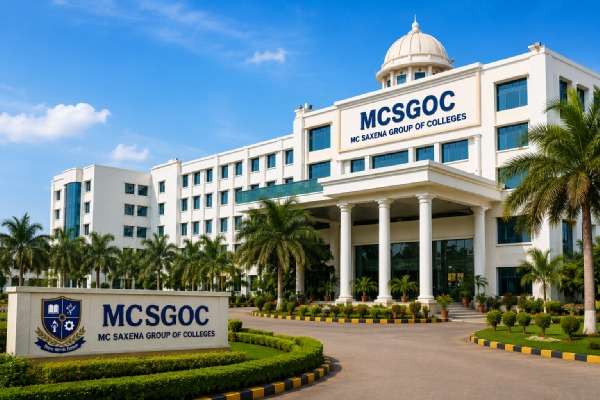
Dr M.C. Saxena College of Pharmacy is a part of the M.C. Saxena Group of Colleges, Lucknow, which is one of the best B Pharm colleges in Uttar Pradesh.
It offers a 4-year Bachelor of Pharmacy (B.Pharma) program, is affiliated with AKTU (Dr A.P.J. Abdul Kalam Technical University), and is approved by AICTE/PCI.
The approximate Total Course Fee for the course can be around ₹3.45 Lakh – ₹4.46 Lakh (for the complete 4-year program)
But let's look at a breakdown of the fee structure for B. Pharma in MC Saxena:
|
Department |
B.Pharm |
|
Seats |
100 |
|
Duration |
4 Years |
|
Eligibility |
10+2 |
|
Fee/Year |
₹1,10,000 + Exam Fee |
|
Hostel Charges (Optional, per year) |
Boys Hostel: ₹50,000 - ₹75,000 Girls Hostel: ₹60,000 |
Please Note the following:
- One-time College and university registration and exam fees are not included in the above tuition fee.
- Uniform charges are billed separately.
- Hostel fees are additional and vary by room type and gender.
Students should still verify the latest PCI approval, affiliation, facilities, admission route, and fee breakup directly with the college before taking admission.
For more information or queries, contact us at ☎️: +91 9936052233 or drop us a mail at mcscet@rediffmail.com.
Final Verdict
Lastly, we have to say that stop romanticising government colleges; not everything can justify low prices. Ideally, you shouldn’t let numbers, specifically fees, become the only deciding factor.
Compare the B Pharm fees in UP, but also compare laboratories, practical training, faculty, infrastructure, industry exposure, internships, placement support, and student facilities.
Irrespective of whether you are choosing a government institution or one of the many private B Pharm colleges in Uttar Pradesh, make sure the programme is properly approved and the fee structure is clearly communicated.
And remember the drill: the earlier you start, the earlier you will reach heights. That said, students can study in one of the best colleges in Lucknow, named Dr M. C. Saxena College of Pharmacy. We have been imparting professional and technical skills as per industry standards to enhance career opportunities across pharmacy fields.
So, don't let your career plans be delayed by uncertainty regarding the fee of B Pharm in UP. Check out MC Saxena's B Pharm program, see what you need to do to get admission, and learn about the fee structure. Then, take the first step toward a career in pharmacy today.
FAQs
Q1: Is a government B Pharm college actually better than a private one, despite lower fees?
A: Well, not really. It is because government colleges often include outdated equipment that won’t match industry standards, poor placement, and limited internship opportunities. On the other hand, private colleges have modern labs and equipment, strong placement support, industry partnerships, and support for career growth.
Q2: Will a private B Pharm degree be accepted by the Pharmacy Council of India?
A: Yes, 100%. The colleges we’ve mentioned in this draft are AICTE-approved, PCI-recognized, UGC affiliated, and DEB-approved. However, students studying in private colleges will be eligible for government pharmacy jobs, retail pharmacy licenses, hospital pharmacy positions, pharma companies, and working abroad.
Q3: What is the average B Pharm fees in UP?
A: It depends on the institution, so we can't mention the exact fee of B Pharm in UP. In general, government colleges charge lower tuition fees, while private colleges can charge anywhere from ₹60,000 to ₹1.5 lakh or more annually. Consequently, we advise students to consult the most recent official fee structure.
Q4: What additional expenses should I consider apart from B.Pharm tuition fees?
A: Besides the fees, a student must keep track of expenses for examination and registration fees, hostel or accommodation, food, transport, books, uniform, practical requirements, and other institutional charges.
Q5: What careers can I pursue after B.Pharm?
A: After getting their B. Pharm, graduates can also work as pharmacists, make drugs, do quality control and assurance, work in regulatory affairs, do clinical research, sell drugs, market them, serve in pharmacovigilance, and opt for further education.