M Pharm Pharmaceutical Chemistry: Career Scope, Salary, and Jobs in 2026
After your B. Pharm marksheet is in your hands, the only question one can think of is “what comes next?”
Well, choosing M Pharm Pharmaceutical Chemistry sounds heavy. Sounds like more and more late nights in the lab. But the truth is that this exact degree is quietly becoming one of the smartest bets in Indian pharma right now.
Is this degree worth another two years of your life? By the time you've finished reading this blog, you'll have a clear understanding of what this degree teaches, how much it pays, and where it leads.
What Is M Pharm Pharmaceutical Chemistry Exactly?
Chemistry M Pharm is a two-year postgraduate specialisation that is a mix of chemistry and drug science. The B. Pharm degree you did in your graduation was a wide overview of pharmacy and drugs. However, this specialisation goes deeper into how drug molecules are designed, synthesised, analysed, and improved.
To put it into perspective: if pharmacology is about how a drug behaves inside the body, pharmaceutical chemistry is about how that drug is built in the first place.
With more than 300 institutes in India offering M Pharm chemistry, the course has become fairly popular among pharmaceutical students. Our country isn't just focused on manufacturing generic drugs anymore. It is seeking innovation, and that needs chemists who understand the structure-activity relationship of drugs and not just learn some formulas from a textbook.
Eligibility Criteria for M Pharm Pharmaceutical Chemistry in India
The eligibility criteria for M Pharm Pharmaceutical Chemistry in India are fairly simple, but every college follows them thoroughly. Let's have a look at them:
-
A Qualifying Degree: You need a B Pharm degree from an AICTE-approved and PCI-recognized institution.
-
Minimum Marks: Most universities have the eligibility criteria of at least a score of 50-55% in B Pharm (There is some relaxation that is usually given for reserved categories).
-
Entrance Exam: Admission to most reputed colleges, especially for scholarship or stipend-linked seats, requires a valid GPAT (Graduate Pharmacy Aptitude Test) score.
-
Some state-level and private colleges also accept admissions directly, or they conduct their own entrance tests.
-
Specialisation Choice: You generally choose pharmaceutical chemistry as your specialisation at the time of counselling or admission. The specialisation you get is based on seat availability and your GPAT rank (if applicable).
-
Registration: You should be a registered pharmacist or eligible to register under the Pharmacy Act, 1948, as required by your state pharmacy council.
Besides all these, you should always recheck a college's exact eligibility criteria on their page before applying. Since the entrance requirements can vary between state universities, deemed universities, and private institutions, check out their website ot page beforehand.
M Pharm Pharmaceutical Chemistry Syllabus
Well before you say yes to a two-year postgraduate course, you should be aware of the M Pharm pharmaceutical chemistry syllabus.
So, it basically covers:
-
Advanced Organic Chemistry: It includes the study of reactions, mechanisms, and synthesis strategies of drugs and medicines.
-
Medicinal Chemistry: You can think of it as a guide for “how drugs are designed to target specific diseases.”
-
Drug Design and Development: Introduction to computer-aided drug design (CADD), QSAR, and molecular modelling.
-
Pharmaceutical Analysis: In this, students learn and get to know about HPLC, GC, spectroscopy, and other analytical techniques
-
Heterocyclic Chemistry: It is the backbone of organic chemistry as it studies cyclic compounds, which is very important while studying medicine.
-
Natural Product Chemistry: This subject isolates and studies bioactive compounds.
-
Research Methodology and Biostatistics: To give you hands-on experience in the research field, your final year will revolve around a real research project.
These subjects are not for “just exams”; every single subject here forms a foundation for a real job role later.
What's the Scope of M Pharm in Pharmaceutical Chemistry?
It is time to answer the most awaited question that every pharmaceutical student has. Here is a straightforward breakdown of the scope of M Pharm in pharmaceutical chemistry that stretches across many sectors:
1. Pharmaceutical R&D
This is the sector that most graduates dream of and aim for in the field of pharma. Here, you work on drug discovery, molecule optimisation, and formulation improvement. Major companies like Dr Reddy's, Sun Pharma, Glenmark, and Cipla are constantly looking for chemists who can improve existing drugs to be better, safer, and more effective.
2. Quality Control (QC) and Quality Assurance (QA)
Every single batch of medicine that is sold out there has to be tested and verified after manufacturing. This is where QC and QA come in. This is one of the most stable, well-structured, and in-demand job roles in this field because no company can sell a drug without QC sign-off.
3. Analytical and Regulatory Roles
If you like precision work, then you will enjoy working in an analytical chemistry role that involves HPLC, mass spectrometry, and method validation. Analytical chemists are professionals who analyse and prove that a drug works exactly the way it claims to.
If you are less of a lab person, you can opt for working in regulatory affairs. Regulatory Affairs Executives are the middlemen between a company's science and drug composition and government drug authorities.
4. Academics and Research Institutes
You can also go for teaching in pharmacy colleges after a postgraduate degree. OR you can go for working as a research associate in CSIR labs, ICMR-affiliated institutes, or university research centers.
5. Government Sector
If you want to work in the Government Sector, then you can opt for Drug Inspector, Drug Control Officer, and Scientific Officer roles in government bodies. These roles are highly regarded because of the job security and steady growth they provide.
6. Higher Studies and Abroad Opportunities
Many people use their M Pharm degree as a stepping stone to get a PhD or an MS abroad. These further studies will later open the door to global pharma and biotech roles.
So, it is safe to say that this degree isn't narrow or one-track. You can explore multiple sectors which match your preferences and skill set. Talking about skill set, let's explore what skills are important for you as a pharma student.
Skills That Matter More Than Your Marksheet
A degree can only give you practical and book knowledge; what actually lands you a job after completing college is the ability to apply your skill set in your job role.
Here are a number of practical skills that matter a lot if you want to work in this field:
-
CADD and Molecular Modelling Software: It is important to have firsthand experience with tools like Schrödinger Suite or similar platforms. Expertise in these tools is increasingly expected in workplaces.
-
ChemDraw / ChemBioDraw Proficiency: It is the industry-standard tool for drawing and communicating chemical structures. Most of the R&D teams out there assume you already know this.
-
Instrumentation Know-How: Students should be comfortable with using HPLC, GC, and spectroscopy equipment, instead of just knowing what the acronyms stand for.
-
Regulatory Documentation Literacy: Make sure to have an understanding of how USFDA, WHO-GMP, and export-market compliance documentation works. It helps you provide a real basis for regulatory affairs roles.
-
Scientific Writing: One should have the ability to write clearly for patents, research papers, or regulatory submissions. Scientific Writing is a surprisingly underrated skill that creates opportunities for medical writing and patent analyst roles.
-
Literature and Patent Search Skills: Knowing how to navigate PubMed, SciFinder, and patent databases efficiently saves your R&D team weeks of unnecessary extra work.
Now that we have discussed what skills you should focus on, let's have a look at what job roles these skills and this degree can land you.
Jobs After M Pharm in Pharmaceutical Chemistry
Here is a list of jobs after M Pharm in pharmaceutical chemistry that most people step into:
- Research Scientist or Research Associate (Research and Development)
- Analytical Chemist
- Quality Control and Quality Assurance Officer
- Formulation Development Scientist
- Regulatory Affairs Executive
- Medical Writer
- Drug Inspector or Drug Control Officer
- Assistant Professor or Lecturer
- Clinical Research Associate
- Patent Analyst
Top recruiters that are actively hiring for these positions include big names like Novartis, Dr Reddy's Laboratories, AstraZeneca, Sun Pharmaceuticals, Glenmark, and Syngene, among other major pharmaceutical companies across India.
And these aren't niche job titles; they exist in almost every mid-to-large pharma company across India and abroad. This means you can expect a dependable and safe job after your degree.
What's the Real Salary Range?
Everyone indeed wants numbers; nobody wants to beat around the bush when it comes to money.
According to industry salary data, the average M.Pharm Pharmaceutical Chemistry salary in India generally falls between INR 3 to 5.5 LPA.
But that's just the starting line, not the finish line. Here's how the trajectory usually looks:
|
Career Stage |
Typical Salary Range (Annual) |
|
Fresher (0-2 years) |
₹3 – 5.5 LPA |
|
Mid-level (3-6 years) |
₹6 – 10 LPA |
|
Senior R&D / QA roles (7+ years) |
₹12 – 20+ LPA |
Obviously, the numbers can vary for everyone depending on their college, skill set, and where they landed their first job. This is just an estimated salary range.
|
Did You Know This Fact?? 🤔 Chemistry-focused pharma professionals who move into broader M Sc pharmaceutical chemistry-style R&D (Research and Development) roles in private companies can see salary averages climb even higher over time. This is especially true in product development and speciality manufacturing roles, where entry-level salaries in pharmaceutical R&D can reach around ₹6 LPA, and mid-career professionals can earn up to ₹10 LPA. |
In this field, salary fairly reflects not just your certificate, but also your skill, your lab experience, and how well you can apply what you learned.
Choosing the Right College for M Pharm Pharmaceutical Chemistry
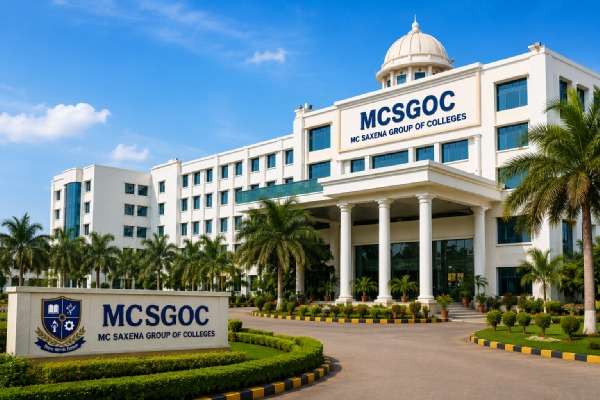
Hands-on experience in a good lab, if not more, is as important as learning all the theories from the textbook, and this is exactly where Dr M. C. Saxena College of Pharmacy shines brightly for students choosing M Pharm Pharmaceutical Chemistry.
Let's not play with words and talk about straight facts. Here is what you can expect from our campus in Dr M. C. Saxena Group of Colleges (MCSGOC) in Lucknow:
-
Recognised Affiliations: We have approvals and affiliations with AICTE, PCI, and AKTU, so your degree carries real weight in the job market.
-
A Research-Ready Campus: Our campus is around 30+ acres, with well-equipped labs built to perform analytical and synthesis work that this field demands effortlessly.
-
Experienced Faculty: We have a strong team of 750+ teaching faculty across MCSGOC. They will help you with guidance in your research project with real industry and academic exposure.
-
A Real Placement Track Record: Our alumni are now working with names like Sun Pharma, Unicore India Limited, Macro Outsourcing (B) Ltd., and other pharma and corporate recruiters.
-
A Dedicated Corporate Relations Department: We actively organise placement drives, industrial visits, and job fairs to connect our students directly with employers.
So, if you're serious about turning your Pharmaceutical Chemistry M Pharm degree into a real career and not just a certificate, M. C. Saxena Group of Colleges is built to get you right there.
Wrapping up
Nowadays, you can't just expect to get a degree and secure any pharma job; things aren’t that simple anymore. Specialisations like M Pharm Pharmaceutical Chemistry are more in demand, and they put you right at the centre of where the pharma scene is growing in India. Employers now want expertise in research, innovation, and quality-driven manufacturing.
It may not be the easiest two years in the lab, but if you really enjoy studying chemistry, it's one of the smartest and future-proof paths you can take in 2026.
Dr M. C. Saxena College of Pharmacy is one of the best options for you in Lucknow, with its AICTE, PCI, and AKTU affiliation and strong placement record. Visit our website to apply for admissions or call us at 9936052233.
FAQs
Q1. What scope does M Pharm in pharmaceutical chemistry in India offers?
A: The scope includes pharmaceutical Research and Development, Quality Control and Quality Assurance Officer, analytical chemistry, regulatory affairs, academics, government drug-control jobs, and opportunities in other countries through higher studies.
Q2. After M Pharm pharmaceutical chemistry, what is the expected average salary?
A: Freshers in this field can earn up to ₹3–5.5 LPA, while mid-career professionals make somewhere around₹6–10 LPA. And senior R and D or QA roles can offer up to ₹12 LPA or more.
Q3. What jobs can I get after M Pharm in pharmaceutical chemistry?
A: There are many job roles you can opt for, including Research Scientist, Analytical Chemist, QC/QA Officer, Formulation Scientist, Regulatory Affairs Executive, Drug Inspector, and Assistant Professor.
Q4. Is the M Pharm pharmaceutical chemistry syllabus difficult?
A: Though heavy on chemistry (medicinal chemistry, drug design), it directly prepares you for R&D and QC/QA roles in pharmaceuticals.
Q5. Can I pursue a PhD after M Pharm pharmaceutical chemistry?
A: Yes, this is one of the most common specialisations for pursuing a PhD in pharmaceutical sciences or an MS abroad due to it being research-focused.