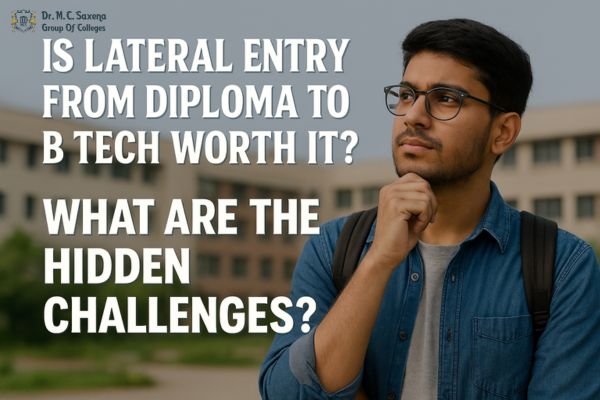
B.Tech Admission Without Entrance Exam in UP — Top Colleges 2026
Ask any Class 12 student what keeps them up at night to pursue engineering. Every 9 out of 10 students will mention “JEE” if they aim to become an engineer. They feel a roller coaster of emotions, from the pressure, the coaching fees, the endless mock tests, and that one terrifying moment when results drop, and everything feels like it either worked or did not.
But the thing many students do not know is: “JEE is NOT the only way to become an engineer in India”.
In reality, over 60% of private engineering college seats are filled through direct
admission, management quota, and state-level counselling, not JEE. For example, many reputable institutions are offering B.Tech admission without JEE in UP, based entirely on Class 12 marks.
If you found yourself in a similar situation, this guide is for you. We’ll walk you through B.Tech admission without entrance exam in UP and top colleges for the same. However, we will help you get into engineering without the JEE pressure.
Can You Get Into B. Tech Admission Without Taking an Entrance Exam?
The simple answer to your question, “Can I get B.Tech admission without JEE in UP?”, is “Yes”. If you mean JEE Main or JEE Advanced, there is no need to appear for the same with private engineering colleges. But the following are the conditions to get admitted:
-
Students with 45-60% in 12th PCM can acquire admission to top-tier private engineering colleges.
-
Direct admission happens 4-6 months BEFORE JEE results. This means you can secure a seat without worrying about the results others are waiting for.
-
The way you can receive a degree is similar to that provided to merit-based students. Same classes, same exams, same placements!!!
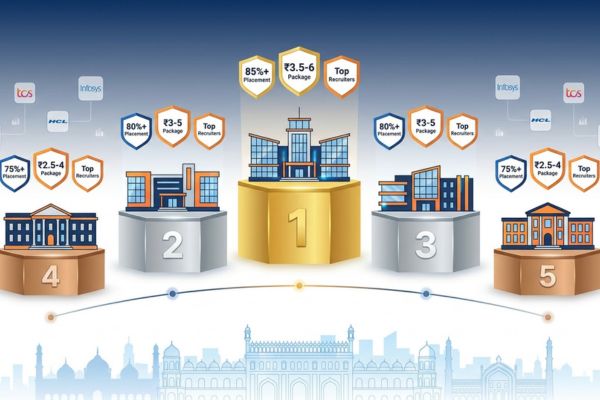
Top 5 Colleges Offering B.Tech Direct Admission
Students who want to take admission in top private engineering colleges in India without giving an entrance exam like JEE can explore the list of the top 5 colleges listed below:
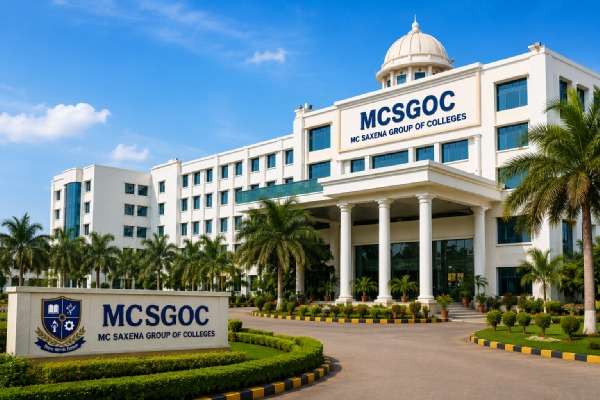
Dr M.C. Saxena College of Engineering and Technology (MCSCET), Lucknow
MCSCET is an AICTE-approved and AKTU-affiliated college direct admission without entrance exam. This college features a 30-acre campus with numerous facilities like labs, a library, and a corporate relations department for placements. However, what you see in the brochure is what you get on campus.
-
Direct Admission Eligibility: Class 12 with a minimum 50% in PCM.
-
B.Tech Branches: CSE, IT, ECE, Mechanical, Civil, and Biotechnology.
-
Fee (Total 4-year): ₹2,44,800 approximately.
Noida Institute of Engineering and Technology (NIET)
NIET is an AICTE-approved and AKTU-affiliated college that is known to provide B.Tech direct admission based on 12th marks UP. Means your degree will carry full national recognition and open doors to competitive exams like GATE and CAT. The college has a strong academic culture and industry-aligned curriculum.
-
Direct Admission Eligibility: Class 12 marks-based (minimum 50% in PCM).
-
B.Tech Branches: CSE, IT, ECE, Mechanical, Civil, and CSE with AI & ML.
-
Fee (Annual): ₹1.8L–2.4L approximately.
Amity University Noida
While many people know Amity University as a premier, private university, many can’t afford to take admission there. It is recognised for its NAAC 'A+' accreditation. Plus, the campus here has a self-contained academic ecosystem with great infrastructure, international faculty collaborations, and a placement cell that attracts Fortune 500 companies.
-
Direct Admission Eligibility: Class 12 marks-based (minimum 60% in PCM) and admission through Amity's own counselling process.
-
B.Tech Branches: CSE, IT, ECE, Mechanical, Civil, Biotechnology, Aerospace, and Engineering.
-
Fee (Annual): ₹3.2L–4.5L approximately.
Manav Rachna University
Manav Rachna University is again a UGC-recognised, NAAC-accredited private educational institution. This university focuses on innovative education, research, and technical prowess. Hence, it is no doubt the most respected engineering university. Despite their academic outcomes, they actively invest in entrepreneurship, innovation labs, sports infrastructure, etc., that produce highly skilled engineers, not just degree holders.
-
Direct Admission Eligibility: A candidate must have secured a minimum 50% marks (with PCM) in their 12th standard or via university-level counselling.
-
B.Tech Branches: CSE, IT, ECE, Mechanical, Civil, CSE with Data Science, and CSE with Cyber Security.
-
Fee (Annual): ₹2.4L–3.1L approximately.
Galgotias University, Greater Noida
Galgotias University (GU) in Greater Noida is among the best names many students rely on. And why not? It is a top-ranked, UGC-recognised private institution known for superb education, huge campus, hi-tech classrooms, and high- quality placements.
-
Direct Admission Eligibility: Class 12 with 50%+ in PCM, NO entrance exam needed.
-
B.Tech Branches: CSE, IT, ECE, Mechanical, Civil, and Biotechnology.
-
Fee (Annual): ₹2.2L-2.8L approximately.
Advantages of Choosing Colleges Without JEE
No JEE stress. No entrance exam pressure. No waiting until August, wondering what happens next. Just a clear pathway into an engineering degree.
Here are the credible reasons why direct admission is a smart move:
-
Flexible Entry: Students can get direct admissions by giving their chosen university exam, admission based on 12th standard grades, or by interview.
-
Saves Time: Clearing JEE takes 12-18 months, whereas direct admission allows students to start college immediately, attend lectures, build projects, and gain real academic exposure.
-
Light on Pocket: Direct admission excludes JEE-related expenses, so you can save more.
-
Good Placements: Many companies consider hiring from these colleges.
-
Same Degree: Candidates will graduate with the same AKTU degree as JEE-admitted students.
Direct Admission Cost vs. JEE Admission Cost
For those who are still sceptical about either getting direct admission or via the JEE route, here is an approximate expense explanation for both ways:
|
Expense |
JEE Route |
Direct Admission Route |
Savings |
|
Coaching (1-2 years) |
₹2-5 lakhs |
₹0 |
₹2-5 lakhs |
|
Entrance exam fees |
₹1,600-5,000 |
₹0 |
Up to ₹5,000 |
|
College admission fee |
₹2-4 lakhs/year |
₹2-4 lakhs/year |
No difference |
|
Total (4 years) |
₹10-20 lakhs |
₹8-16 lakhs |
₹2-4 lakhs saved |
|
Time lost retrying exam |
4-6 months |
0 |
4-6 months gained |
Final Words
By now, you might have understood that JEE is not a barrier to engineering. It is one of many doors. Somehow, if you have missed out on the JEE entrance exam or don’t have a budget or time to get on it, that doesn’t mean missing out on your dreams.
With multiple direct admission B.Tech colleges in Uttar Pradesh, you still have an opportunity to build a successful engineering career. And worry not, these ways are legitimate, take place in reputed private colleges, offer high-quality placements, and give you a full-proof career in engineering.
Colleges like MCSGOC are genuine institutions with strong placements, industry partnerships, and global recognition.
FAQs
Q1: Which college is best for B.Tech. without an entrance exam?
A: There is no such thing as “best”. It all depends on your preferences, branch chosen, location, and budget. And when you choose MCSGOC, you can get all of them under one roof.
Q2: What are the top 5 branches of BTech?
A: The best 5 branches of BTech are: Computer Science Engineering (CSE), Artificial Intelligence & Machine Learning (AI-ML), Electronics & Communication Engineering (ECE), Mechanical Engineering, and Data Science.
Q3: How is MCSGOC's direct admission different from other colleges?
A: MCSCET is majorly known for its transparency of faculty, campus, etc., and merit-based direct admissions. In addition, they vouch for affordability (₹2.44L total fees for BTech), quality faculty, strong placements, and a supportive campus culture.
Q4: Is there a waiting period before starting college when I take direct admission B.Tech colleges in Uttar Pradesh?
A: Even though you are taking direct admission in a college, there will be no waiting period before starting college. Just remember, many colleges start their classes by mid-July to early August, depending on the academic calendar.